Personal Finance Intelligence
Debt snowball vs avalanche: a worked example
Both methods pay the minimum on every debt and put all extra money on one debt at a time. They only differ in which debt gets the extra money first.
- Avalanche: the debt with the highest interest rate first. It costs the least interest.
- Snowball: the debt with the smallest balance first. You clear a debt sooner, which many people find motivating.
When a debt is paid off, its minimum payment is not spent elsewhere: it rolls over to the next debt. That roll-over is what makes either method much faster than paying minimums only.
The example
Three debts with a total of 13,800, and 200 a month on top of the minimum payments (580 a month in total):
| Debt | Balance | Interest per year | Minimum per month |
|---|---|---|---|
| Credit card | 4,000 | 21.9 % | 100 |
| Car loan | 9,000 | 6.5 % | 250 |
| Store card | 800 | 9.0 % | 30 |
The result
| Strategy | Debt-free after | Total interest | Order paid off (month) |
|---|---|---|---|
| Avalanche | 27 months | 1,529.30 | Credit card (16), store card (17), car loan (27) |
| Snowball | 27 months | 1,636.62 | Store card (4), credit card (17), car loan (27) |
| Minimum payments only | 73 months | 4,374.39 | Store card (30), car loan (41), credit card (73) |
Avalanche saves 107.32 in interest over snowball here, and both finish in the same month. Snowball pays off its first debt in month 4 instead of month 16. Paying only the minimums takes almost four years longer and costs about 2,845 more in interest than avalanche.
Even without the extra 200, rolling each paid-off minimum into the next debt (avalanche order) finishes in 46 months with 3,675.03 of interest, still well ahead of minimums only.
Which one should you choose?
If the gap in interest is small, as it is here, pick the one you will stick with. When one debt has a much higher rate than the others (a card at 25 % next to a loan at 4 %), avalanche saves noticeably more. When you have several small balances, snowball clears them fast and frees their minimums early.
Run it with your own debts
- In PFI, add each loan or credit card as an account with what you owe.
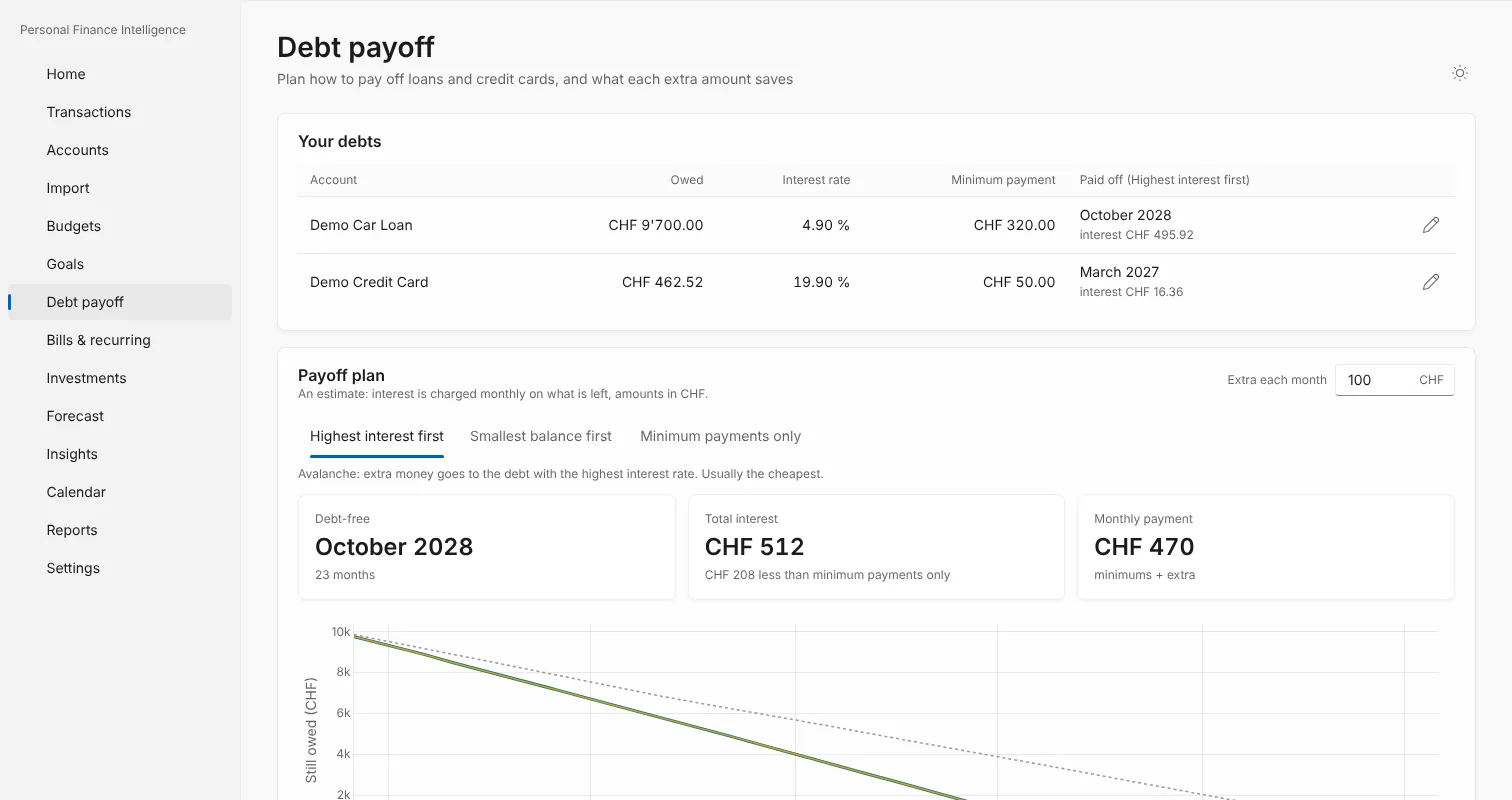
- Open Debt payoff, and enter the interest rate per year and the minimum payment of each debt.
- Type the extra amount you can pay each month. PFI shows highest interest first, smallest balance first and minimum payments only side by side, with the debt-free date and total interest of each.